
 HR
HR EN
ENFind an alternative way to store food. Remove it from the refrigerator to enjoy better flavor, longer freshness, and a smaller electricity bill
- Category: Raw Food

Many fruits release ethylene gas as they ripen. Most people place tomatoes in a paper or plastic bag so they ripen faster. This is why putting vegetables into a refrigerator is counterproductive, because the ethylene that forms concentrates inside the bag around the produce or fruit, which then decays more quickly.
Refrigerators are a relatively recent invention. For thousands of years, people managed perfectly well without them, so they had to discover how to store provisions through winter and summer without spoilage. Today many refrigerators are filled with foods that would keep just as long, and even taste better, than the items you pushed into the fridge and completely forgot.
I refuse to accept the idea that every challenge requires a high tech solution. Consider the work of the Korean designer Jihyun Ryou. When we hand over responsibility for looking after our food to a machine such as a refrigerator, we stop observing food and the natural processes at play. In doing so, we learn nothing.
This designer developed a series of contemporary solutions inspired by traditional techniques that she learned from her grandmother or from other elders in the community where she lived.
Within such communities, knowledge was passed on orally and grounded in practice. In other words, through trial and error.
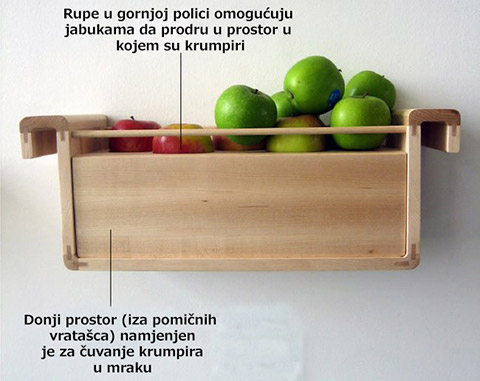
IMAGE 1. APPLE AND POTATO SYMBIOSIS
Here is a striking and slightly intricate example. Many fruits release ethylene gas as they ripen. Most people place tomatoes in a paper or plastic bag to help them ripen faster. This is precisely why putting vegetables into a refrigerator is counterproductive, because the ethylene produced concentrates inside the bag around the produce or fruit, which then decays more quickly. Some vegetables, however, respond differently to ethylene. Potatoes and onions, for instance, will not sprout when exposed to this gas. If you place a banana and a potato in the same bag, the banana will eventually rot while that same potato will not sprout.
Apples release higher levels of ethylene as they ripen and in this way they accelerate the ripening of the fruit and vegetables you store beside them. Yet when apples are kept with potatoes, those same potatoes will not sprout.

© jihyun ryou
IMAGE 2. STORING ROOT VEGETABLES IN SAND
The image above shows the designer’s recommendation for storing root vegetables. When root vegetables are kept upright, the plant can conserve energy more easily and stay fresh for longer. This kind of rack allows them to stand securely, while the sand they sit in maintains ideal humidity.
Keeping vegetables in slightly damp sand was a method used for centuries. Low temperature is ideal for carrots, while high humidity is a crucial condition for storage. Storing in moist sand is an effective compromise. It is only important to remember to add a little water from time to time.
© jihyun ryou
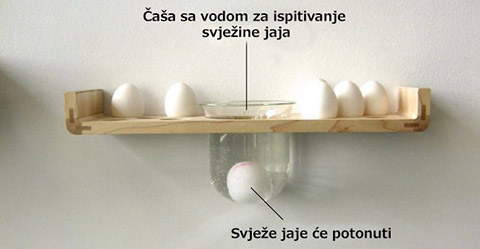
IMAGE 3. EGG STORAGE
Eggshells are covered in millions of tiny pores. Through these pores an egg readily absorbs surrounding odors and substances. Stored in a refrigerator with other foods, an egg can take on unpleasant flavors. With this rack, eggs can be kept outside the fridge, and you can test their freshness with water. The fresher the egg, the deeper it sinks.
The following has been established:
- If the egg sinks to the bottom and stays there, it is 3 to 6 days old
- If the egg sinks and rests on the bottom at an angle, it is more than one week old
- If it sinks and stands on its larger end, it is two weeks old
- If it floats, the egg is too old and should be discarded immediately
Eggs behave this way in water because each egg contains a natural air cell. As an egg ages, this cell grows, since an eggshell is a semipermeable membrane. As the air cell expands, the egg floats higher in the water. As a rule of thumb, eggs remain suitable for consumption for three weeks after purchase.
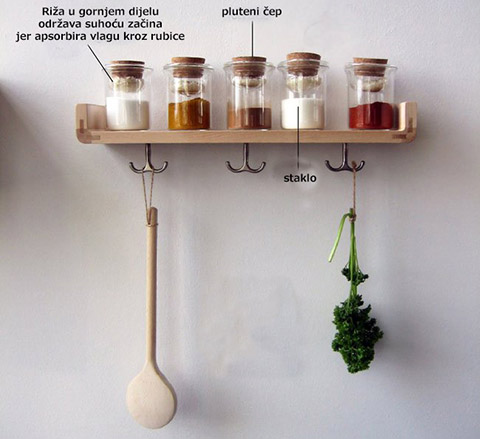
This is the best known idea among those listed. Add a little rice to your spice jars. Rice absorbs moisture and keeps the spices dry.
© jihyun ryou
IMAGE 4. PROTECTING SPICES FROM MOISTURE
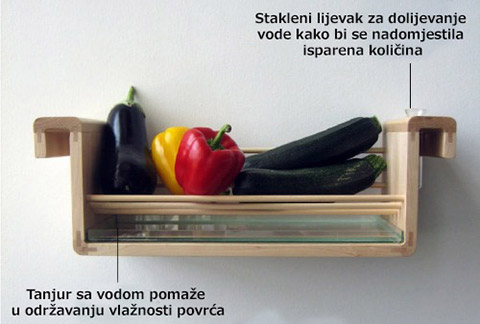
One way to maintain humidity for vegetables is to place them on a shelf that has a shallow dish of water at its base. During the day the water evaporates and gently humidifies the vegetables above the shelf. Use a glass funnel to add water.
© jihyun ryou
IMAGE 5. MAINTAINING VEGETABLE MOISTURE
The more food you keep outside the refrigerator, the smaller your refrigerator can be, and smaller refrigerators consume less electricity and energy. The designs above present a refreshing way to achieve this, although it should be noted that these are designer pieces. If you use the suggested methods in a cellar, you will get even better results.
Compact refrigerators use less energy and of course take up less space, which makes them attractive for city apartments and compact galleys on board. These are not relics of the past. They are templates for our future.


