
 HR
HR EN
ENTwelve Food Additives You Should Avoid
- Category: Raw Food

Yet we must remember that the long term effects of a given chemical often become evident only after extended use, consumption, or exposure. The situation is not black and white; it is shaded in many tones of gray. For their part, food manufacturers interpret these issues in ways that serve their interests alone. In my view, there is no need to dissect their position, because you will arrive at several clear conclusions.
After five years at the Faculty of Food Technology, countless visits to food production facilities, and work in the distribution of additives for that same industry, one thing remains certain. There is always something new to learn. Each day brings information that contradicts what came before. Formal training teaches one thing, the media push another, while personal experience suggests something else entirely.
Whom should we trust?
A reasonable answer would be to trust yourself. Yet do the facts you rely on come from the eating habits you formed in the environment where you lived and still live, from information found online, from books and newspapers, or from ideas absorbed almost unconsciously after endless hours of television?
What I can share here, and what relates to the topic above, is my own experience. At university we learned that not all additives are harmful, that the E numbers assigned to additives exist for classification, and that as consumers we can be confident these substances have undergone detailed safety checks. We also learned that harm depends on the quantity consumed, which applies to virtually everything we ingest. I agree with this entirely. Remember the well known case of a woman who suffered water intoxication after drinking an enormous quantity of water. Even so, we must keep in mind that the long term effects of a specific chemical often emerge only after prolonged use, consumption, or exposure. The picture is not black and white; it is shaded in many tones of gray.
On the other hand, the food industry interprets all of this in a way that benefits it exclusively. Which is why, if you ask me, there is no need to explain their stance in detail, because you will reach a few conclusions:
- It is not in the industry’s interest to produce goods with a long shelf life (consider how quickly white bread goes stale).
- At its core, the food industry is profit driven and focused on financial accumulation.
- The final and most important conclusion: if something has a very long shelf life, avoid it. You can be confident it is packed with additives to achieve such longevity.
So what should we eat? If everything is laden with additives, are we meant to live on air and water alone? If you live in a city, you can be sure that neither the air you breathe nor the water you drink is entirely clean. We could go round in circles without ever arriving at a clear solution to the challenges of modern life.
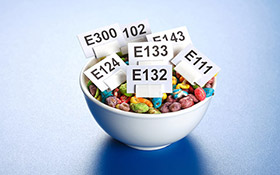
It is true that certain ingredients are not good for our health. Yet we cannot spend our lives in a state of paranoia, fearing that every bite might cause illness.
For example, lemon juice is an effective preservative. White vinegar is a preservative, as are honey, sugar, and salt. The list of natural ingredients long used for preserving food is extensive, and every culture has its own methods of keeping food safe to eat.
To be concise, the purpose of this article is to draw your attention to twelve additives that deserve particular scrutiny.
The “magic” practiced by food technologists has profoundly shaped modern food production and processing. It enables food to last longer, taste better, look more appealing, sometimes carry greater nutritional value, and be easy to prepare.
Perhaps we would all fare better if we ate food native to our region, prepared from a handful of simple ingredients, and served immediately after cooking. In short, as our forebears did. Yet imagine that each of us both wishes to live this way and has the time and skills to do so. That is idealistic. The endless aisles in shopping malls show how unprepared most people are for such an approach and prove that many simply prefer to buy convenience foods that are already processed.
To satisfy demand for all these products, the food industry has developed a wide array of additives that can affect a food in many ways, from flavor to texture. Some even give a product a shelf life measured in years. This is unsettling.
Of the ten thousand food additives currently permitted in the United States, some are highly problematic because they are linked to a range of health issues. They warrant caution and careful attention if they have not already been banned. If you regularly eat processed food, as most people do, how can you be sure that what you consume is safe? Do you know what you should avoid?
Food manufacturers will certainly not tell you. And to be frank, any country that lists ten thousand different food additives and authorizes their use by the general population will not be fully transparent with consumers. Even so, we can identify twelve legal additives you would be wise to avoid.
Here are the twelve offenders we have flagged:
- Nitrites and nitrates
- Potassium bromate
- Propyl paraben
- Butylated hydroxyanisole (BHA)
- Butylated hydroxytoluene (BHT)
- Propyl gallate
- Theobromine
- Undisclosed proprietary flavorings
- Artificial colors
- Diacetyl
- Phosphate based food additives
- Aluminum based additives
Some of these additives are likely carcinogenic to humans, such as nitrites. Others are known endocrine disruptors, such as propyl paraben. Some have been linked to lasting respiratory harm, such as diacetyl. Others still have uncertain provenance, including artificial colors and flavor ingredients.
Coming tomorrow: detailed insights into each of the twelve additives listed above, where they are found, and the research that has confirmed their adverse health effects.


